Yes, you can buy a qualifying property in Dubai without ever boarding a flight. A non-resident can sign, pay, and register a purchase from home using a Power of Attorney, and the Dubai Land Department will issue the title deed in your name. The one catch is the visa itself: the Golden Visa needs you in the UAE for a short while to give fingerprints and sit a quick medical check.
So the honest answer is a split one. The property purchase is fully remote. The Golden Visa is almost fully remote, with one short trip at the end. Here is exactly how both parts work.
What the Golden Visa needs from your property
The real estate route to the 10-year Golden Visa rests on one number. You need to own property worth at least AED 2 million at the time of purchase. That can be one home or several homes added together, as long as the title deeds are in your name and the total clears AED 2 million.

The official Dubai Land Department service page describes it plainly: it is for a real estate investor who owns property with a purchase value equal to or above 2 million AED, and the outcome is a 10-year renewable residence permit. You can confirm the current terms on the Dubai Land Department Golden Visa service page.
A few details matter here:
- Mortgaged property counts now. You no longer need the full AED 2 million paid in cash. If you have a UAE mortgage, the bank issues a No Objection Certificate confirming you have paid at least AED 2 million of equity, and that satisfies the threshold.
- Off-plan can qualify. Buying one or more off-plan units worth AED 2 million or more from an approved developer can also open the route, though a completed, registered property is the cleaner path.
- The property must be in a freehold area. Non-residents can only own outright in designated freehold zones, places like Dubai Marina, Downtown Dubai, Palm Jumeirah, and Business Bay.
The visa gives you a 10-year stay, the right to sponsor your spouse and children, and no need for a local sponsor. It is residency, not a passport. Your own passport still decides where you can travel visa-free, with a handful of countries making exceptions for UAE residents.
The one part you can’t do remotely
The Golden Visa application includes biometrics. That means fingerprints and a photo taken in person, plus a short medical fitness test and the Emirates ID enrolment. None of these can be done from your living room.
In practice, most remote buyers plan one short trip to Dubai after the purchase is registered. A few days is usually enough to finish the medical, give biometrics, and collect the Emirates ID. The visa is then issued, often within a few weeks.
Key point: You can buy the property without visiting. You cannot finish the Golden Visa without a short visit. Budget for one trip near the end.
Everything before that final trip, finding the home, signing, paying, and registering the title, can happen while you stay home.
How the remote purchase works, step by step
Here is the full remote process, in order.
- Pick the property and confirm it is freehold. Work with a RERA-licensed agent (the Real Estate Regulatory Agency sits under the Dubai Land Department). Ask for the agent’s licence number and verify the property is in a freehold zone. Video tours and virtual walkthroughs stand in for a physical viewing.
- Reserve and sign the agreement. For a resale, you and the seller sign a Memorandum of Understanding (often called Form F). For off-plan, you sign a Sales and Purchase Agreement directly with the developer. These can be signed by courier, by digital signature, or by your representative under Power of Attorney.
- Set up your Power of Attorney. This is the document that lets a trusted person in Dubai act for you at every counter. More on this below, because getting it right is where most remote deals slow down.
- Open a UAE bank account and move the funds. Under current Dubai Land Department rules, the money has to run through a UAE account in the exact name on the title deed. Set this up early.
- Get the developer’s No Objection Certificate. For a resale, the seller clears any outstanding service charges and the developer issues an NOC that clears the way for transfer.
- Register at the Dubai Land Department. Your representative attends a DLD-authorised trustee office, pays the fees, and the new title deed is printed, often the same day. For off-plan, you first receive an Oqood certificate, which converts to a title deed once the building is finished.
A newer option avoids even the representative for some steps. The DLD’s Smart Trustee service and the Dubai REST app now support video-conference transfers, with identity checked by facial recognition in the app. Where it is available, this can register the transfer without a POA holder standing in for you. Ask your agent whether your specific transaction qualifies.
Here is the quick version of what is remote and what is not.
| Step | Can it be done remotely? |
|---|---|
| Viewing the property | Yes, by video tour |
| Signing the MOU or SPA | Yes, by POA or e-signature |
| Paying the developer or seller | Yes, through a UAE account |
| Registering the title at DLD | Yes, by POA or video transfer |
| Golden Visa biometrics and medical | No, needs a short trip |
Setting up your Power of Attorney
A Power of Attorney, or POA, is a signed document that names a person in Dubai to act for you. With it, that person can sign the sale papers, attend the trustee office, and collect your title deed. Without a correctly attested POA, a remote deal cannot register.
The document has to travel through an attestation chain before the UAE will accept it. There are two common routes.
The embassy chain. You sign the POA before a notary in your home country. It then goes to your country’s foreign ministry, then to the UAE embassy or consulate in your country, and finally to the UAE Ministry of Foreign Affairs once it reaches Dubai. If the original is not in Arabic, you also need a certified Arabic translation. The whole chain usually takes about two to four weeks.
The remote UAE e-notary. Dubai Courts and the Ministry of Justice run an electronic notary service. A UAE-registered notary attests your POA on a recorded video call while you hold your passport to the camera. This is often faster, a week or two, and skips part of the embassy chain.
A few rules that save headaches:
- Keep it specific and recent. The DLD prefers a POA that clearly spells out the power to buy and register this property, and it generally will not accept a POA more than two years old.
- Handling your money needs extra wording. The DLD only lets your representative receive or pay purchase funds if the POA says so in plain terms, so make sure the drafting covers it.
- Match every name. The name on your passport, your title deed, and your UAE bank account must all read the same, letter for letter.
Paying for the property from abroad
Money is the part people underestimate. Three things matter.
You will need a UAE bank account. Current DLD rules mean non-residents transact through a UAE account held in the buyer’s own name, and third-party accounts are no longer allowed. Banks that open non-resident accounts include Emirates NBD, Mashreq, ADCB, FAB, and HSBC UAE. Expect to provide your passport, proof of address at home, bank statements showing your source of funds, and the signed sale agreement. Minimum balances often run from AED 25,000 upward.
Off-plan money goes into escrow. To protect buyers, the DLD requires payments for off-plan homes to go into a developer-specific escrow account, with funds released to the developer against construction milestones. Always ask for the official escrow account details, check the account name matches the developer, and never send money to a personal account.
Mind the currency. The dirham is pegged to the US dollar, so dollar buyers face little swing, but anyone converting from another currency should watch the exchange rate and transfer fees on a sum this size. Locking in a rate can save a meaningful amount on a AED 2 million purchase.
What it costs beyond the price
The sticker price is not the whole bill. Set aside roughly 7 to 9 percent on top for fees. The main ones:
- DLD transfer fee: 4 percent of the property value. On a AED 2 million home that is AED 80,000. It is legally split between buyer and seller, but in practice the buyer usually pays the full amount unless negotiated.
- Trustee office fee: around AED 4,000 for a property at this value.
- Title deed and admin fees: a few hundred dirhams, plus DLD admin charges up to AED 5,000.
- Mortgage registration (if financing): 0.25 percent of the loan amount, paid to the DLD.
- Agency fee: commonly around 2 percent of the price, plus VAT.
- POA costs: the attestation chain runs anywhere from a few hundred to a few thousand dirhams depending on your country and route.
Then there are the Golden Visa fees themselves, paid when you apply, which cover the medical, Emirates ID, and visa issuance.
Common mistakes that trip up remote buyers
A remote purchase is routine now, but a few things still catch people out.
Buying outside a freehold zone is the big one. Only designated areas allow full foreign ownership, so confirm the zone before you commit. Working with an unlicensed broker is another; always check the RERA licence. A POA that is too vague, too old, or missing the power to handle funds will stall the registration, so have it drafted by someone who knows DLD requirements. And underestimating annual service charges, which developers often ask for in advance, can dent your first-year budget.
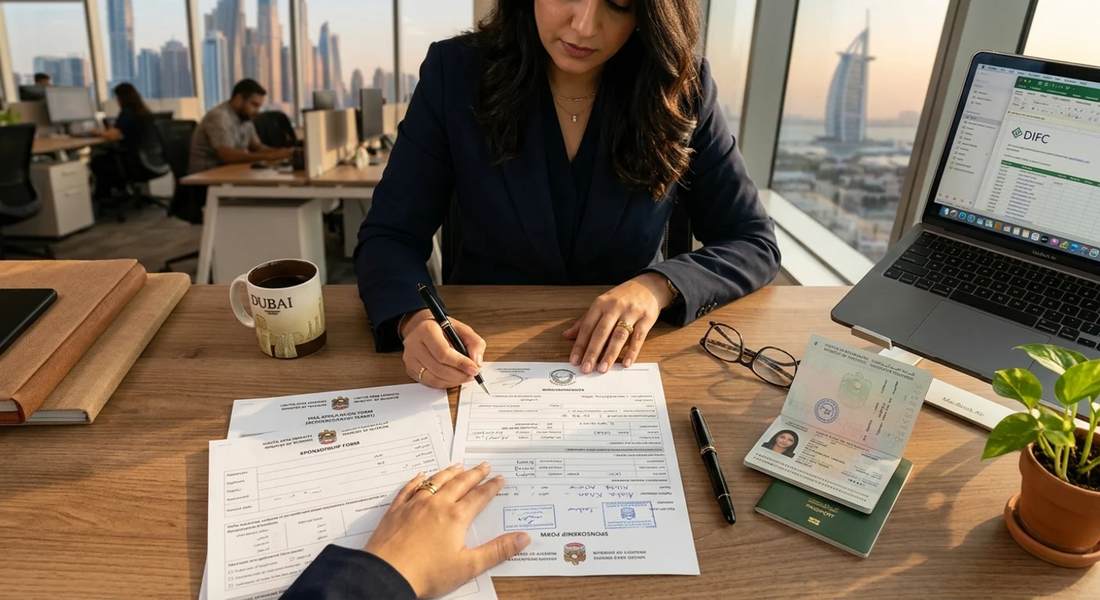
One more: do not assume the visa is instant the moment you own the property. The property gives you the right to apply. The application, biometrics, and medical still have to be completed before the Golden Visa is in your hand. You can read the full residency terms on the official UAE government Golden Visa page.
Frequently asked questions
Can I buy a property in Dubai without ever visiting the UAE?
Yes, for the purchase itself. A notarised, attested Power of Attorney lets a representative sign, pay, and register the title for you, and the DLD issues the deed in your name. Only the Golden Visa step needs a short visit.
Do I need to visit Dubai to get the Golden Visa?
Yes, briefly. The Golden Visa requires in-person biometrics, a medical fitness test, and Emirates ID enrolment, which cannot be done remotely. Most buyers plan one short trip after the property is registered.
How much property do I need for the UAE Golden Visa?
At least AED 2 million in value, held in your name as one or more properties. Mortgaged property counts if a bank confirms you have paid AED 2 million of equity. The visa lasts 10 years and is renewable.
What is a Power of Attorney and why do I need one?
It is a signed, attested document naming someone in Dubai to act for you. It lets them sign the sale papers, attend the DLD trustee office, and collect your title deed. Without it, a remote purchase cannot register.
What extra costs should I budget beyond the price?
Roughly 7 to 9 percent. That covers the 4 percent DLD transfer fee, the trustee and admin fees, agency commission, POA attestation, and, if you finance, a 0.25 percent mortgage registration fee. Golden Visa fees come on top.
Conclusion
You can buy a Dubai property for the Golden Visa without visiting, as long as you do it in the right order. Set up a specific, well-attested Power of Attorney, open a UAE bank account in your own name, buy in a freehold zone for at least AED 2 million, and register the title through your representative or a video transfer. The purchase is fully remote. Then plan one short trip for biometrics and the medical, and the 10-year visa follows.
Recommended Articles:
Can a Golden Visa Entrepreneur Open a Company Bank Account in the UAE?
Which UAE Banks Offer Mortgages for Golden Visa Property Buyers
Issue With Property Valuation Below AED 2 Million For Abu Dhabi Golden Visa Equity
How to Apply for the Entrepreneur Golden Visa: The ICP Nomination Process in the UAE
Why Do Free Zone Employees Need a Salary Certificate for a Golden Visa?


![How ato Replace a Lost Emirates ID on a Golden Visa [[;](https://www.goldenvisauae.net/wp-content/uploads/2026/11/How-to-Replace-a-Lost-Emirates-ID-on-a-Golden-Visa-150x150.jpg "How to Replace a Lost Emirates ID on a Golden Visa 5")